
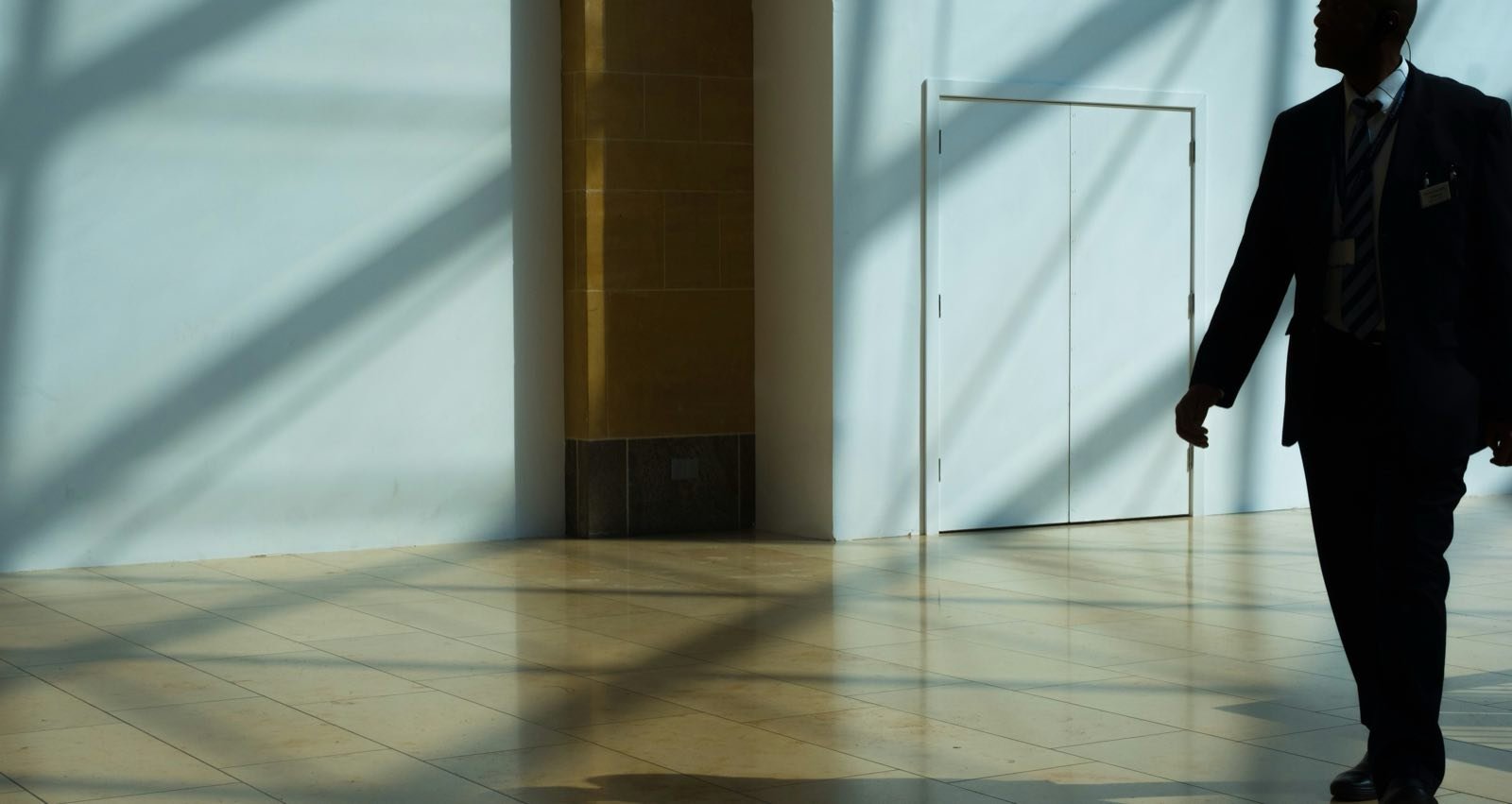
Uniforms
Uniform to your requirement, quoted separately
Optional on any assignment we staff: your branding, corporate front-of-house dress, or high-visibility kit for a post that is outdoors all night. Specified in writing, and never added to an invoice you have not approved.
An option, not an extra
The uniform is the first thing anyone sees, and usually the only thing they remember
Our officers arrive in uniform as standard. What is optional is uniform specified by you — carrying your branding, matching your colours, or dressed for the way your building actually reads to the people walking into it. If you want that, we arrange it, and it is quoted separately from the guarding rate.
A visitor to your building forms a view of your organisation before anybody speaks to them, and the officer at the door is what they form it from. That works both ways. A well-turned-out officer in kit that fits reads as a business that runs itself properly. A borrowed coat over a polo shirt in the wrong colour reads as a business that cuts corners — and the visitor has no way of knowing the corner was cut by the contractor rather than by you.
So we treat the uniform as part of the assignment specification rather than as something the officer sorts out. It is agreed in writing before the first shift, alongside the patrol route and the escalation order, and it is replaced to the same specification when it wears out rather than quietly drifting into whatever is in the van.
What you can specify
Uniform to your requirement, not to ours
Any combination of these, on any assignment we staff. What is right depends on the post rather than on the size of the contract.
Standard guarding uniform
What officers wear by default: shirt or polo, softshell or fleece, tailored trousers and a weatherproof outer layer. Plain, dark, unmistakably corporate security.
Corporate front-of-house dress
For receptions, head offices and residential lobbies, where a guarding uniform reads as a threat rather than a welcome. Suit, shirt and tie, with the security function carried by the badge rather than the coat.
Your branding applied
Your logo embroidered or heat-sealed at an agreed position, in your colours, with name badges if you want them. We will tell you honestly whether the artwork you have will stitch cleanly at that size.
High-visibility and outdoor kit
Where the site calls for it — gatehouses, yards, construction and night work — hi-vis to the class your own risk assessment specifies, with waterproof and thermal layers for a post that is outdoors for twelve hours.
Visible identification
The SIA licence carried where it can be seen and read, plus photo identification and, where you want it, a name badge. An officer nobody can identify is an officer nobody can hold to account.
Replacement for the life of the contract
Garments replaced to the same specification when they wear, fade or no longer fit — not substituted for the nearest thing available. Colour drift across a team is what makes a uniform stop looking like one.
What good actually means
Six things a uniform has to do
Every security company says its uniform is high quality. These are the things that decide whether it is, and you can check all six yourself on the first shift.
It has to survive a shift, not a photograph
Twelve hours, outdoors, in weather, washed after every one of them. Garments are chosen on fabric weight, seam construction and how they come out of a sixtieth wash — not on how they look folded in a catalogue.
It has to fit the person wearing it
Officers are measured individually rather than issued the nearest size in the bag, and women's kit is cut for women rather than being a small men's shirt. Bad fit is the single most common reason a uniformed team looks unprofessional.
It has to carry the licence visibly
A front-line SIA licence has to be worn and readable while the officer works. The garment has to have somewhere for it to live that survives putting a coat on, which a surprising amount of security kit does not.
It must not be mistakable for police uniform
Wearing anything resembling police uniform so as to deceive is an offence under section 90 of the Police Act 1996. Chequered banding, rank-style epaulettes and constabulary-pattern badges are ruled out at specification, before anybody orders them.
It has to match the site, not just the brand
A concierge in hi-vis looks wrong and a yard officer in a suit is unsafe. The specification follows what the post actually is, which is something we work out at the site survey rather than guess from the address.
It has to be reproducible in six months
One replacement garment in a slightly different shade undoes the whole effect. Specifications record the exact garment, colour reference and branding position, so the twentieth one matches the first.
How it is arranged
Four steps, and a price before an order
Nothing is bought on your behalf until you have seen the figure and approved it in writing.
Raised at the site survey
Uniform is one of the questions on the free survey. We will also say if the honest answer is that you do not need it — a retail observation post works better in plain clothes, and we would rather tell you that than sell you shirts.
Specified in writing
Garments, colours, branding and its position, identification, sizes and quantity are written down and attached to the assignment instruction, so the uniform is documented in the same place as the patrol route.
Quoted before anything is ordered
You get a written figure, separate from the guarding rate, and nothing is bought until you have approved it. There is no margin hidden inside an hourly rate for this.
Fitted, issued and maintained
Officers are measured and issued before their first shift on your site, spares are held for cover officers, and worn garments are replaced against the same written specification.
If you take it up
What you receive
Set out here so there is no ambiguity later about what the separate quotation actually buys.
Included in the quotation
- A written uniform specification attached to your assignment instruction
- Your branding applied at an agreed position, on agreed garments
- Officers measured individually, in a cut that fits them
- SIA licences carried visibly on every shift
- Replacement garments to the same specification, for the life of the contract
- A separate written quotation before a single item is ordered
Questions
Uniforms: common questions
Is uniform included in your hourly rate?
Our officers arrive in uniform as standard, and that is included. What is optional, and quoted separately, is uniform specified to your requirements — your branding, your colours, or a particular style of dress for your building. It is never added to an invoice without a written quotation you have approved first.
Can you put our logo on the officers' uniform?
Yes, embroidered or heat-sealed, at a position agreed with you. What we need from you is usable artwork: a vector file, or a large clean image. A logo pulled off a website at screen resolution will stitch as a blur, and we would rather tell you that before the order than after it.
Can officers wear plain clothes instead?
Yes, and on some assignments it is the better answer. Uniform deters; plain clothes observes. Retail loss prevention in particular often works better with a uniformed officer at the door and a plain-clothes officer on the floor. It is decided per post, in the assignment instruction.
Who owns the uniform when the contract ends?
Whatever is agreed in writing before the order is placed. Branded garments carrying your logo are a different conversation from stock items, and it is a conversation worth having at the start rather than at the end, so nobody is left holding a hundred shirts with somebody else's name on them.
How long does it take to arrive?
Stock garments are quick. Anything branded takes longer, because it has to be embroidered or printed after it is ordered. The lead time is stated in your written quotation before you approve it, so it is never a surprise — and where cover is needed before branded kit lands, officers work in our standard uniform in the meantime.
Want your officers in your own uniform?
Tell us about the site and what you want the officers to look like walking into it. The survey is free, and the uniform is quoted separately, in writing, before anything is ordered.